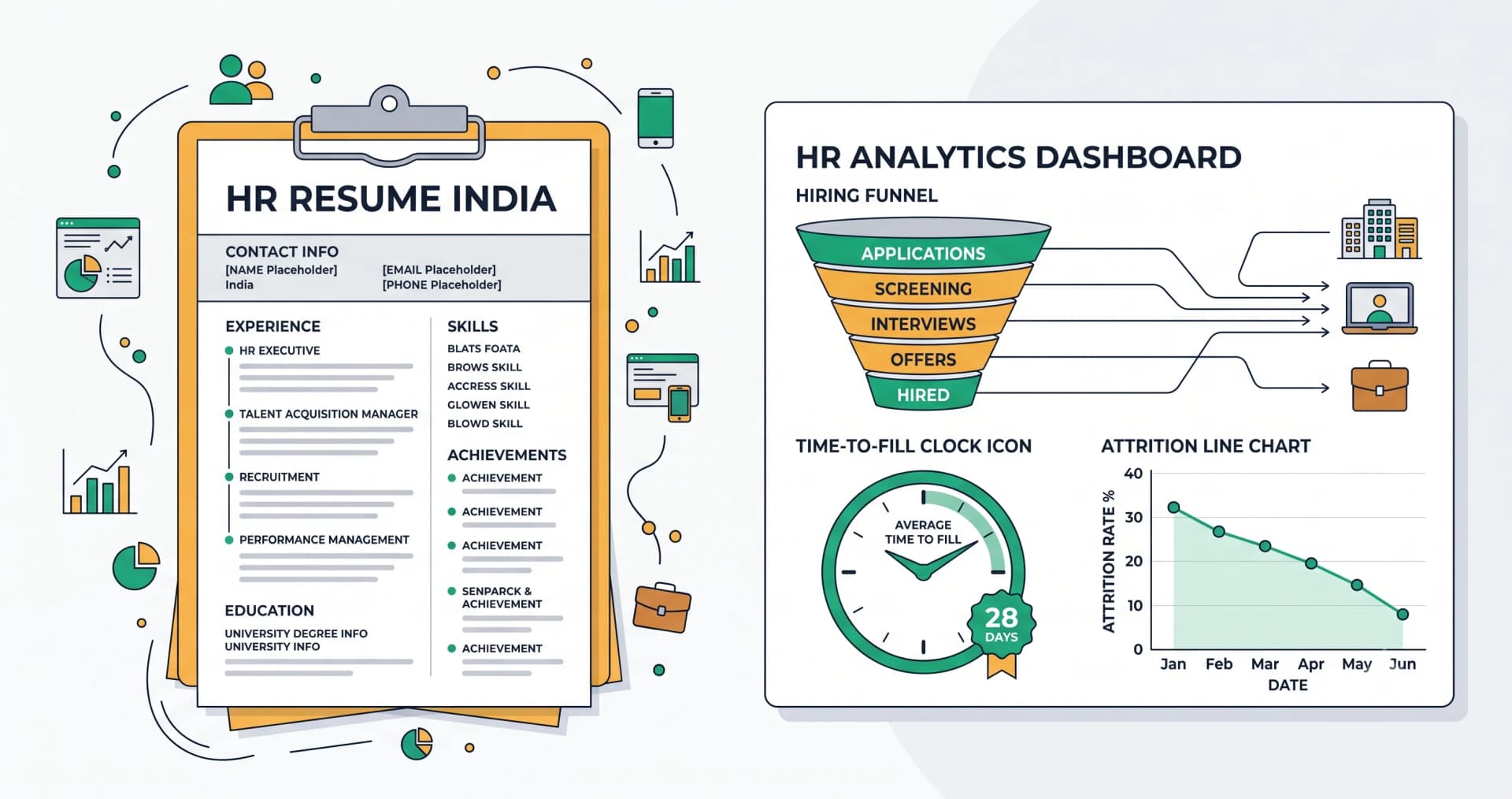
HR covers wildly different jobs under one label. The first thing your resume must do is say which one you do, because a talent acquisition specialist and an HR business partner share almost no daily work.
Name your track in the first line
- Talent acquisition — sourcing, screening, closing
- HR operations — onboarding, payroll inputs, HRIS, documentation
- HRBP — performance, engagement, org design, manager coaching
- Compensation and benefits — banding, benchmarking, appraisal cycles
- Learning and development — training design and delivery
Recruitment numbers
Volume alone is meaningless without difficulty. Twenty niche senior engineering hires is harder than a hundred entry-level BPO seats, and a good HR manager knows it.
Handled end-to-end recruitment for technical and non-technical positions.
Closed 47 roles in FY25 (32 engineering, up to Staff level) with median time-to-fill of 38 days; raised offer-acceptance from 64% to 81% by restructuring the interview loop from 6 rounds to 4.
HRBP and operations numbers
- Headcount supported — 'HRBP for 320 employees across 3 business units'
- Attrition — voluntary attrition reduced from X% to Y%, and what you did
- Cycle delivery — appraisal cycles run, on time, for how many people
- Engagement — survey participation and score movement
- Cost — cost-per-hire, agency spend reduced, payroll error rate
Compliance is worth a line in India
PF, ESI, gratuity, POSH committee work, labour-law filings, state-wise Shops and Establishments compliance, statutory audits. Most HR resumes omit these and most Indian employers need them. One line covering what you've handled is genuinely differentiating.
Systems
Darwinbox, Keka, Zoho People, SAP SuccessFactors, Workday, greytHR, Naukri RMS, LinkedIn Recruiter. Say which you've administered rather than just used — configuring an HRIS is a different skill from filling in its forms.
Put this into practice
Build, score and tailor your resume with JotCV — free plan, no card needed.
Write an HR resume