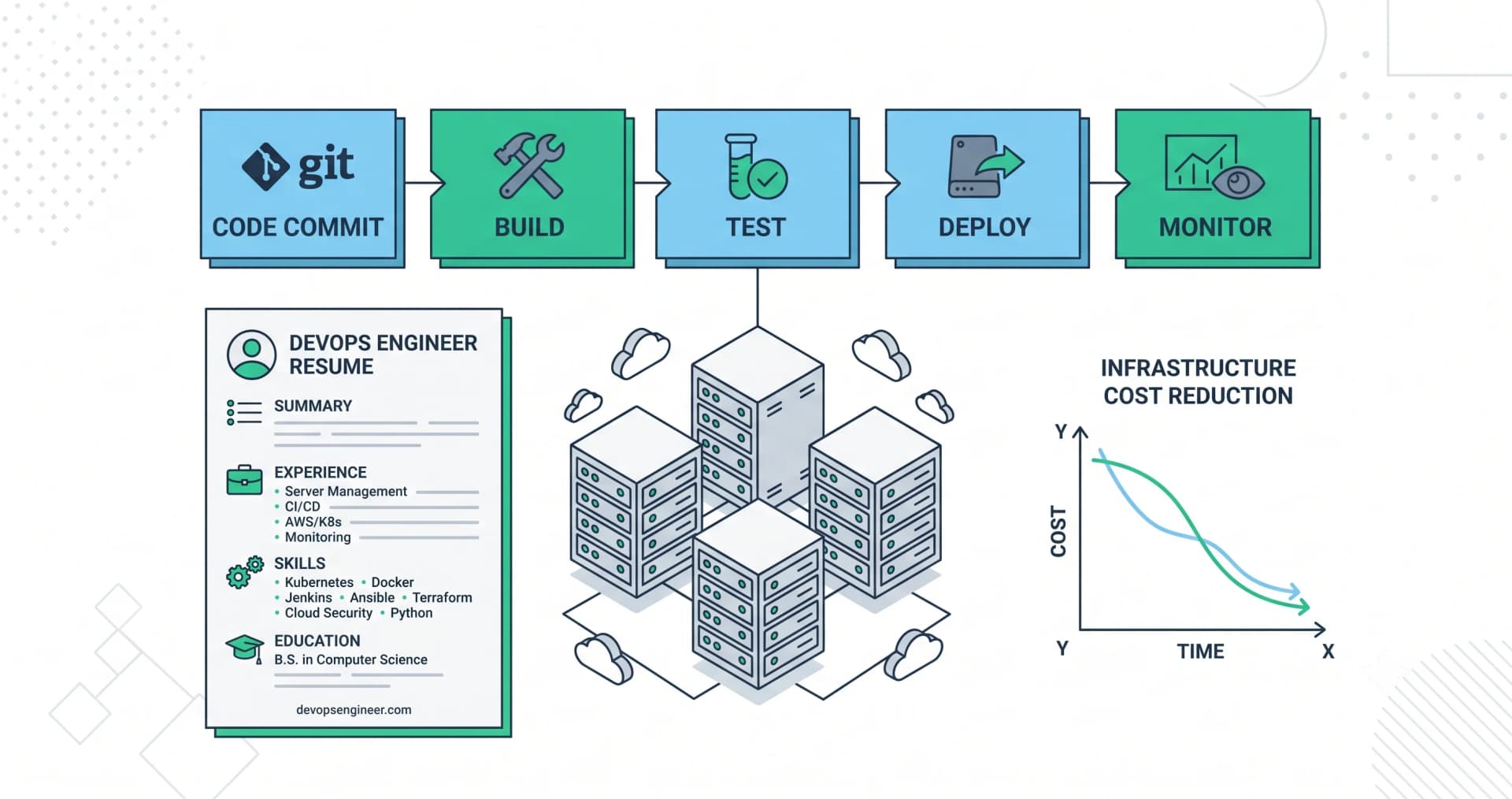
Every DevOps resume lists Docker, Kubernetes, Jenkins and Terraform. What distinguishes the shortlist is operational evidence: what you ran, how often it broke, and what you did about it.
The four numbers that define the role
- Deploy frequency — 'moved 14 services from fortnightly to on-demand deploys, ~40/week'
- Lead time — 'cut build-to-production from 3 days to 40 minutes'
- MTTR — 'reduced mean time to recovery from 90 to 22 minutes with automated rollbacks'
- Cost — 'cut AWS spend 34% (₹18L/year) via right-sizing and spot instances'
Describe scale, not just stack
'Managed Kubernetes' covers both a three-node test cluster and a 200-node production fleet. Say which: number of clusters, nodes, services, environments, and whether you were on call for them.
Managed Kubernetes clusters and CI/CD pipelines using Jenkins and Terraform.
Ran 3 EKS clusters (≈120 nodes, 60 services) across dev/stage/prod; replaced hand-built Jenkins jobs with Terraform-defined GitHub Actions pipelines, cutting pipeline maintenance from ~6 hours/week to under 1.
Incidents are evidence, not embarrassment
One bullet about a real incident — what broke, how you found it, what you changed so it couldn't recur — is worth more than three bullets of tooling. It's also the question you'll be asked in the interview, so having the story ready on paper works in your favour.
Certifications that carry weight in India
CKA and CKAD are respected because they're practical exams. AWS Solutions Architect Associate is widely asked for in job postings. Terraform Associate helps for platform roles. List the ones you hold with the year; drop expired ones.
Security and compliance
If you've handled secrets management, SOC 2 or ISO evidence collection, RBAC design or VPC segmentation, say so explicitly. Indian enterprises and any company selling to the US or EU filter for it, and few candidates mention it.
Put this into practice
Build, score and tailor your resume with JotCV — free plan, no card needed.
Score your DevOps resume