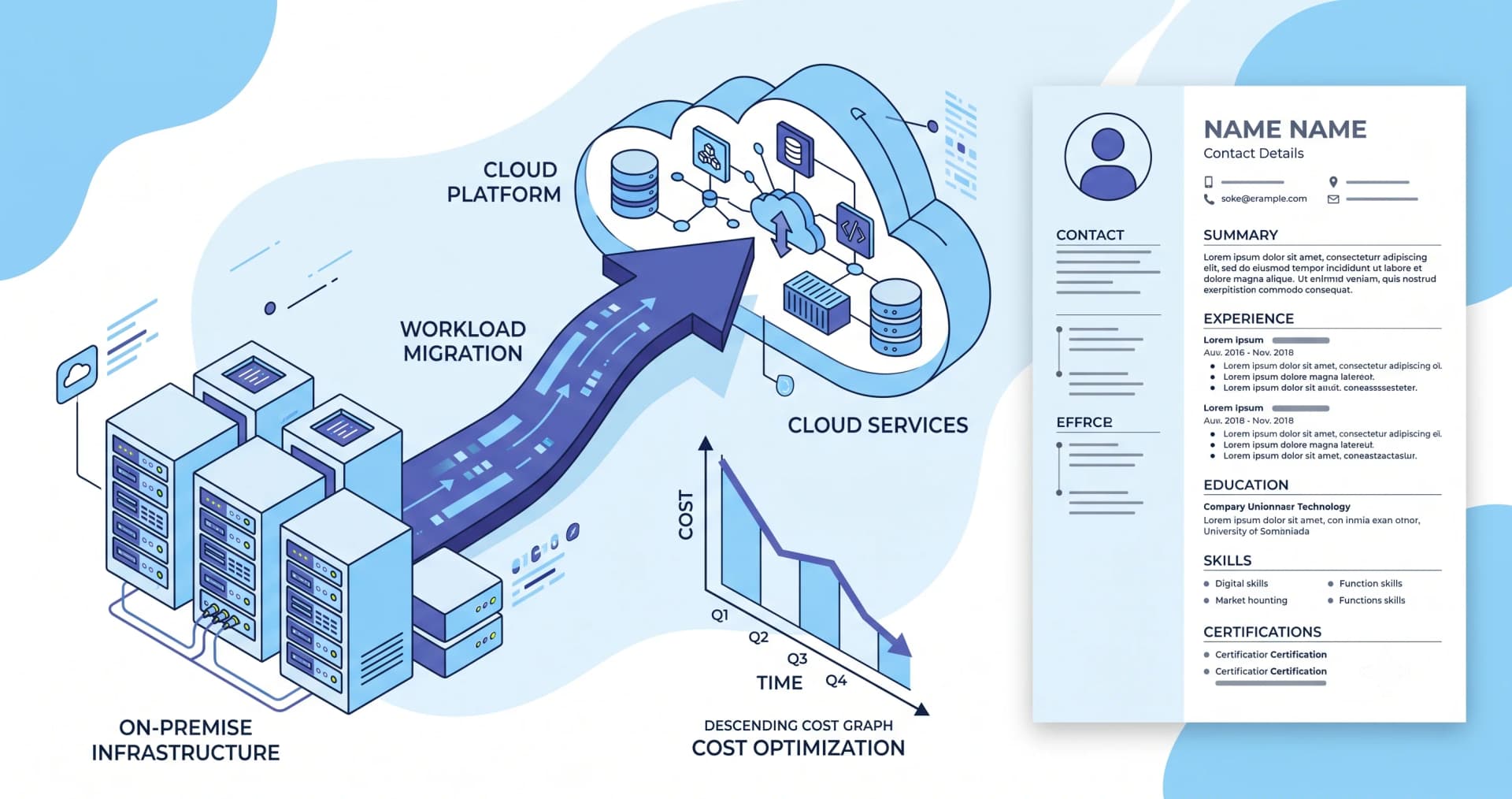
Writing 'AWS' on a resume tells a reader nothing — it covers someone who launched one EC2 instance and someone who runs a multi-account landing zone. Specificity is the whole game here.
Name services, not platforms
Replace the platform name with the services you've actually operated, and add the scale beside them.
Experienced in AWS cloud services and infrastructure management.
AWS: EKS, RDS (Postgres, 2TB), S3, CloudFront, Lambda, IAM across 4 accounts under AWS Organizations; owned the Terraform modules used by 5 teams.
Migration work is the highest-value story
Indian enterprises are still mid-migration, and a candidate who has completed one is valuable. Give it a structured bullet: what moved, from where, how long, what broke, and what it cost or saved.
'Migrated 23 services from on-prem VMware to AWS ECS over 7 months with under 4 hours total downtime; annual infrastructure cost fell 28%' is worth an interview on its own.
Cost engineering — the underused differentiator
FinOps work is in demand and rarely mentioned. Reserved instances, savings plans, spot usage, storage lifecycle policies, right-sizing, idle-resource cleanup — if you've done any of it, put the rupee or dollar figure on the resume.
Certifications employers filter on
List the certification, the issuing body and the year. An expired certification with no date looks like padding.
- AWS — Solutions Architect Associate is the common filter; Professional signals senior
- Azure — AZ-104 for administrators, AZ-305 for architects
- GCP — Associate Cloud Engineer, Professional Cloud Architect
- Kubernetes — CKA carries weight across all three clouds
Security, because it's usually missing
IAM policy design, network segmentation, secrets management, encryption at rest, audit logging — most cloud resumes skip these entirely, which makes mentioning them a fast way to stand out for enterprise roles.
Put this into practice
Build, score and tailor your resume with JotCV — free plan, no card needed.
Match a cloud job description