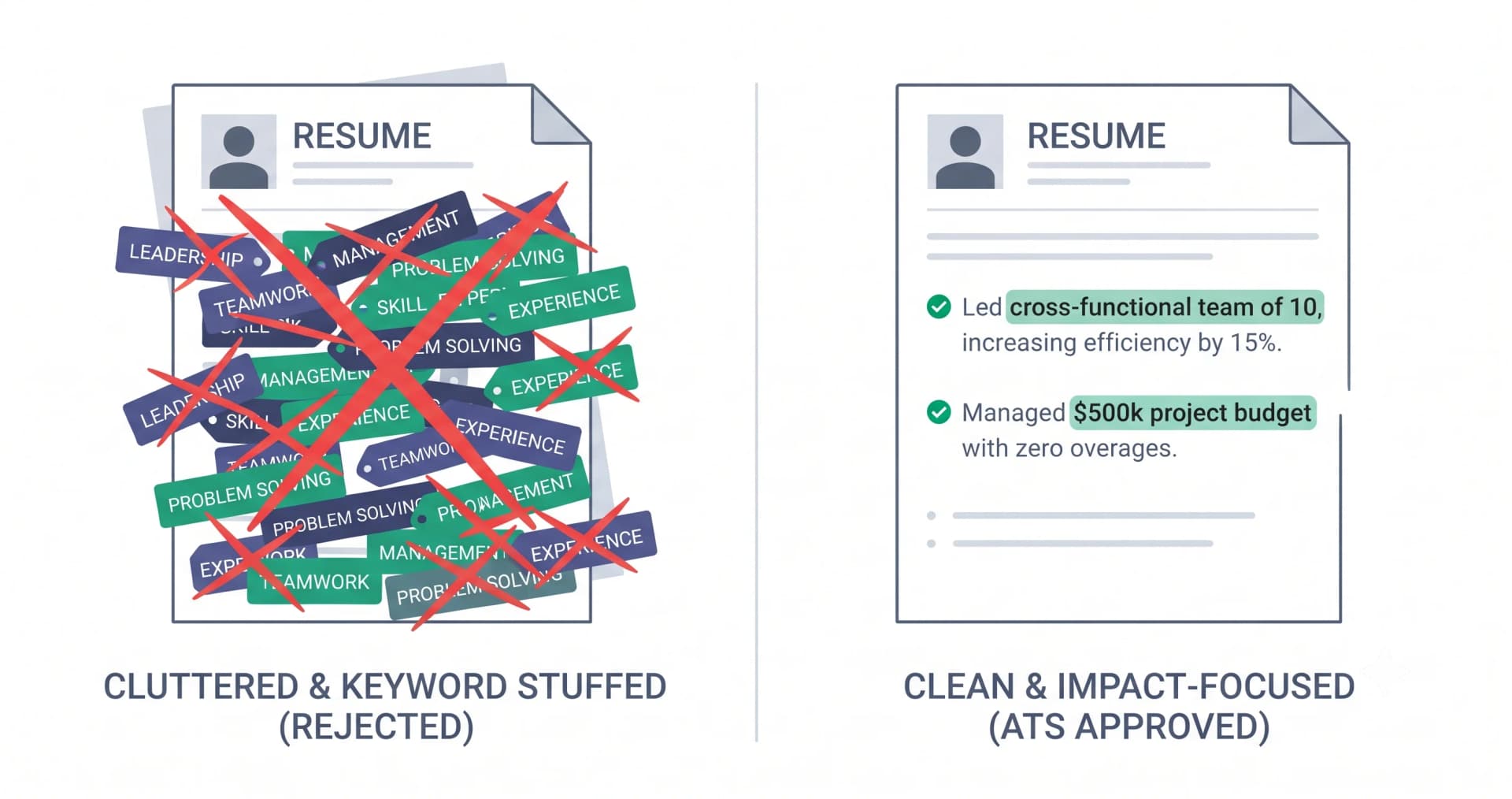
Keyword stuffing is what happens when you optimise for the first gate and forget the second. The good news is that the two goals almost never conflict — a bullet that proves you did the work contains the keyword automatically.
Write the evidence, get the keyword free
Start from what you actually did, at the level of detail you'd use explaining it to a colleague. The tools name themselves.
Skilled in Python, Django, REST API, PostgreSQL, Redis, Celery, Docker, AWS, CI/CD, Agile, Scrum, Git, JIRA
Built the settlement API in Django and PostgreSQL, moving reconciliation to Celery workers and cutting the nightly run from 3 hours to 20 minutes.
The second version contains four of the same keywords inside a sentence that makes a recruiter want to ask a follow-up question.
Keep the skills list, but make it honest
A skills section is still the right place for exact-string matching, and recruiters do scan it. Keep it to things you could be interviewed on, grouped so it can be read in one glance.
- Languages — Python, JavaScript, SQL
- Frameworks — Django, React, FastAPI
- Infrastructure — Docker, Kubernetes, AWS (EC2, S3, RDS)
- Practices — CI/CD, code review, on-call
The three-mention ceiling
If a keyword already appears in your title, your skills list and one bullet, adding a fourth mention adds nothing to your score and starts to read badly. Spend that line on a different capability instead — coverage beats repetition.
What genuinely raises a score without stuffing
- Adding a missing section the job asks for (Certifications, Projects)
- Naming the exact tool version or cloud service, not the category
- Including the job's own title somewhere true — in your summary line, for instance
- Spelling out acronyms once so both forms match
Put this into practice
Build, score and tailor your resume with JotCV — free plan, no card needed.
Rewrite a bullet with AI