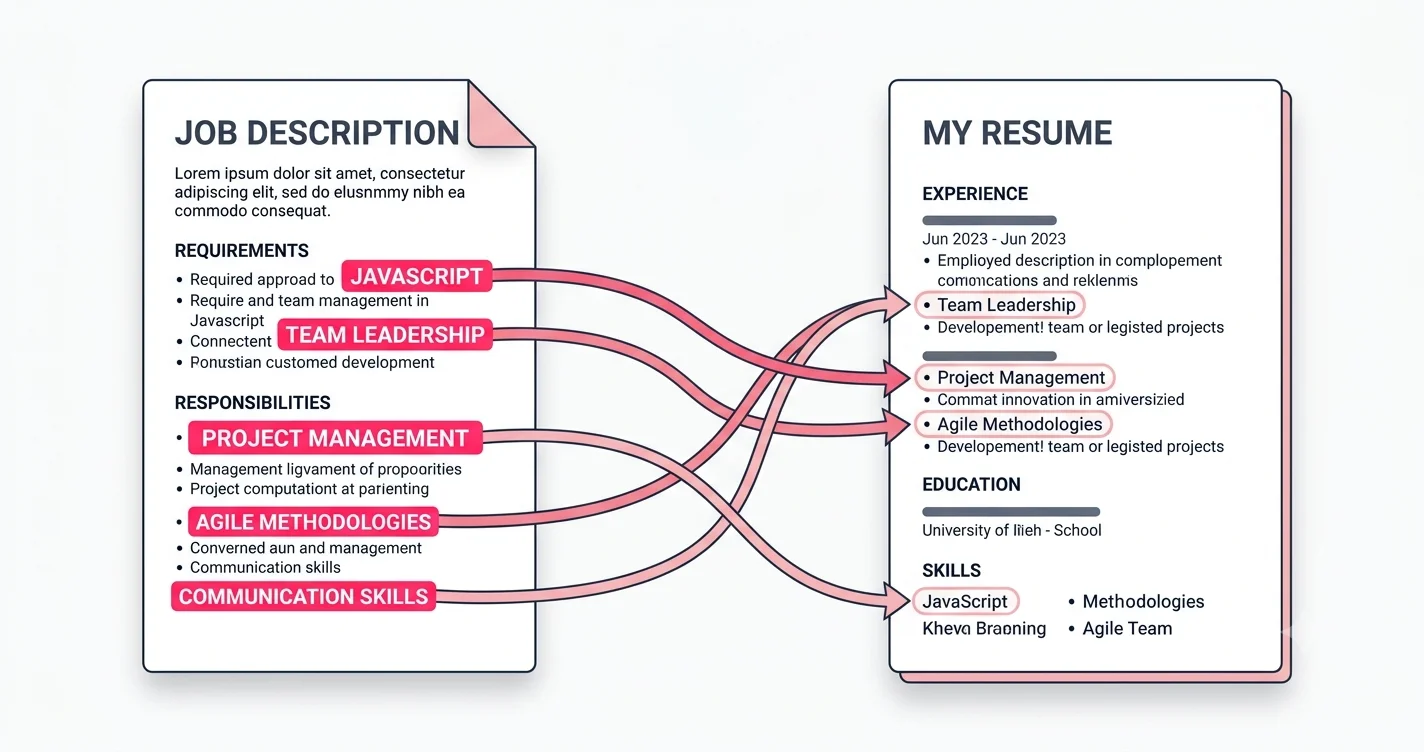
Most advice about ATS keywords stops at "use words from the job description". That leaves the hard part unanswered: which words, how many, and where. Here is the method we built into JotCV's ATS checker, written out so you can do it by hand.
Only three parts of a job post are worth mining
A typical Indian job posting runs 600–900 words, and more than half of it is boilerplate about the company. Ignore that. Keywords worth extracting sit in exactly three places: the job title, the 'Requirements' or 'Must have' list, and the first four bullets under 'Responsibilities'.
Everything after the fourth responsibility bullet is usually padding written by someone who had a template to fill. Recruiters skim the same way.
Separate hard requirements from nice-to-haves
Split what you found into two columns. A hard requirement is a named tool, language, certification or measurable quantity: Python, Kubernetes, GST filing, IELTS 7.0, 5+ years. A nice-to-have is a soft or optional phrase: 'exposure to', 'familiarity with', 'bonus if'.
Hard requirements you genuinely have must appear on your resume, spelled exactly as the posting spells them. Nice-to-haves are worth a mention only if they are true and you have space.
Match the exact string, then the variant
Parsers match text, not meaning. If the posting says 'Node.js' and your resume says 'NodeJS', a naive keyword matcher scores you zero on it. The fix is not to pick one — it is to use the posting's spelling in your skills list and the natural spelling in your bullets.
- Skills line — copy the posting's exact string: React.js, PostgreSQL, CI/CD
- Bullets — write the way a human speaks: "built the React front end", "tuned slow Postgres queries"
- Acronyms — put both forms in once: "Search Engine Optimisation (SEO)"
Where to put them so the resume still reads well
Keyword placement has diminishing returns. The first mention in a bullet carries almost all the weight; the fourth mention of the same word carries none and makes you look desperate.
Aim for each critical keyword to appear twice: once in your skills section, once inside a bullet that shows you actually used it. That second appearance is what survives a human read.
Skills: Python, Python scripting, Python automation, Python 3, advanced Python
Skills: Python, Django, PostgreSQL Experience: Automated daily reconciliation in Python, cutting a 3-hour manual process to 8 minutes
Same keyword, two placements, and the second one gives a recruiter a reason to call you.
The words that quietly cost you points
- Generic filler — 'hardworking', 'team player', 'go-getter'. No ATS scores them and no recruiter believes them.
- Internal jargon — your last company's project codenames mean nothing outside it. Translate them.
- Skills with no evidence — listing a tool you touched once is the fastest way to lose a technical interview.
Common questions
How many keywords should a resume have?
There is no magic number. Cover every hard requirement you genuinely meet — usually 8 to 15 for a technical role — and stop. Adding keywords you can't defend lowers your interview conversion even when it raises your parse score.
Does white-text keyword stuffing still work?
No, and it gets you blacklisted. Every major ATS extracts text regardless of colour, and recruiters who spot hidden text treat it as dishonesty. It has been a reliable way to get rejected for at least a decade.
Put this into practice
Build, score and tailor your resume with JotCV — free plan, no card needed.
Check your resume against a job description