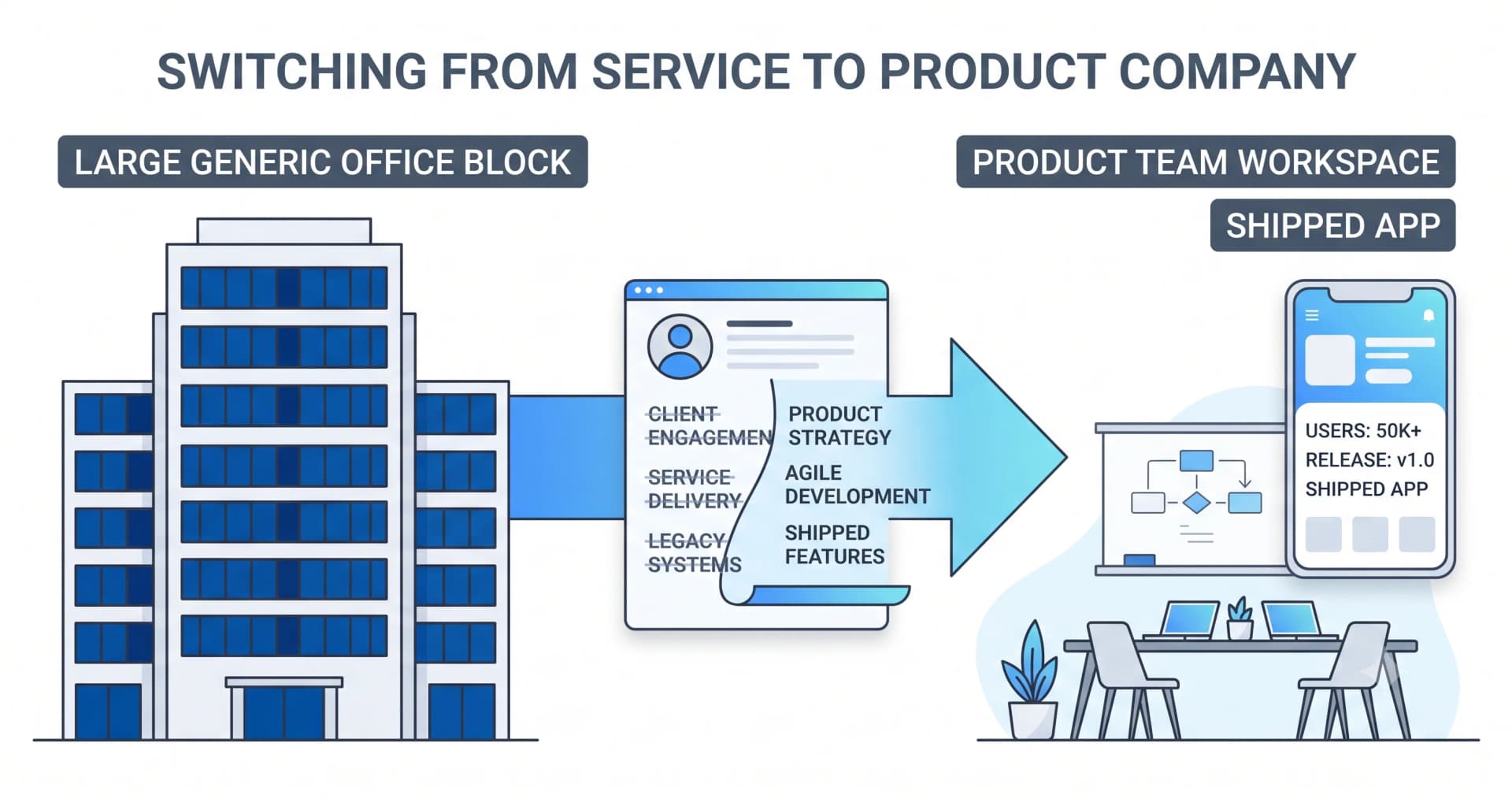
This is the most common career move in Indian tech and the one where resumes let people down hardest. Service-company work is genuinely valuable; it's usually described in a way that hides the value.
What product companies screen for
- Ownership — did you decide anything, or implement decisions
- Depth — one system understood thoroughly beats five touched briefly
- Engineering practice — testing, code review, CI/CD, on-call
- Problem-solving signal — DSA rounds, system design, or visible work
- Users — did anything you built get used by real people at scale
Translate client work into product language
NDAs stop you naming the client, not the work. Describe the domain, the scale and your role in the decisions.
Worked on an application for a leading US-based insurance client as part of a 30-member team, handling development and maintenance activities in Java.
Backend developer on a claims-processing platform for a US insurer (~90k claims/day); owned the document-ingestion service end to end, cut OCR retry failures from 8% to 1.4%, and introduced contract tests that ended a recurring integration break with the policy team.
Close the practice gaps before applying
Service-company environments often don't offer modern engineering practice, and interviewers probe exactly there. If your project had no automated tests, no code review culture or no CI, learn those on a side project before you interview — they're the questions where candidates from services backgrounds most often stumble.
The interview format is different
Product companies typically run DSA rounds, a system-design round and a deep dive on your own project. None of these resemble a services interview. The project deep dive is where service-company candidates do best, because they have real production experience — prepare it as carefully as the algorithms.
Levelling and compensation
Expect to be levelled on scope rather than years. Seven years of maintenance work may map to a mid-level product role, and that's not an insult — the compensation band usually still moves up. Going in expecting a title match and refusing on principle costs people good moves regularly.
What genuinely transfers and is undervalued
Working with demanding external clients, delivering under fixed deadlines, documentation discipline, debugging systems you didn't write, and coordinating across teams and time zones. Product companies are frequently weak at all of these. Say so on the resume — it's a real differentiator, not a consolation prize.
Put this into practice
Build, score and tailor your resume with JotCV — free plan, no card needed.
Rewrite your project bullets