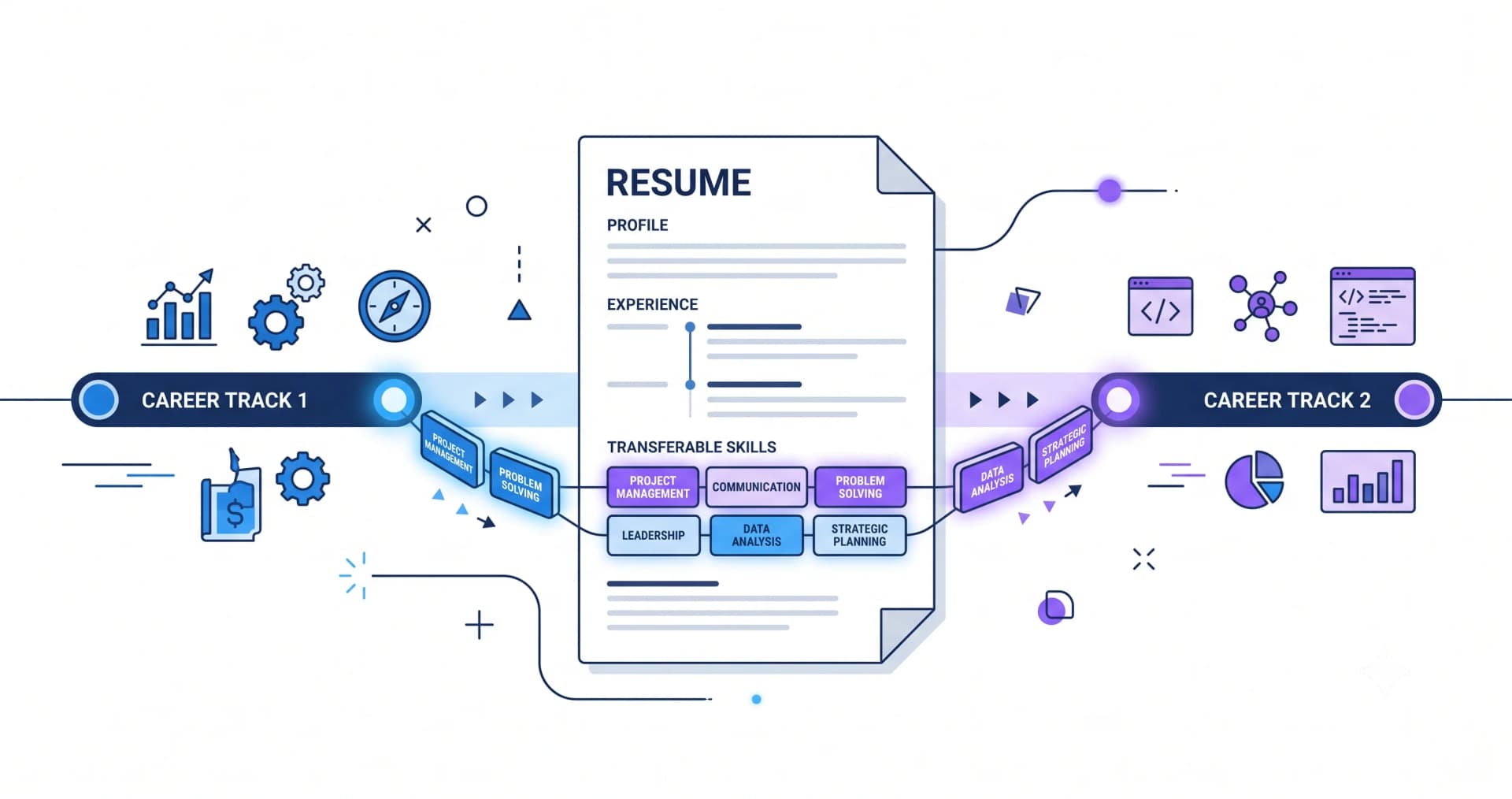
A career-change resume has to do something a normal one doesn't: answer 'why is this person applying?' before the reader decides not to care. That answer goes at the top, not in a cover letter nobody opens.
Lead with the bridge
Your summary is the most important two lines on a career-change resume. State the switch, the reason it makes sense, and the proof you've already started.
Experienced operations professional seeking to transition into a data analytics role where I can apply my analytical skills.
Six years running retail supply-chain operations across 40 stores, now doing the analysis myself in SQL and Power BI. Built the demand-forecast model that cut stockouts 18% in my current role. Moving into a full-time analyst position.
Find the overlap that's real
Most switches have more genuine overlap than the job titles suggest. Teachers moving into L&D already design curriculum and manage a room. Operations people moving into product already write requirements and negotiate priorities. Support engineers moving into QA already reproduce bugs and write repro steps.
Name the overlap explicitly rather than hoping a recruiter infers it — they won't, in the seconds available.
Rewrite old bullets in the new field's vocabulary
Same facts, different framing. The work you did doesn't change; which parts you foreground does.
Managed daily store operations including inventory, staff rosters and vendor coordination for 40 outlets.
Owned weekly inventory analysis across 40 outlets (~12k SKUs); built the Excel and SQL reporting that drove replenishment decisions, cutting stockouts 18% and dead stock 22%.
Evidence beats intention
Everyone switching says they're passionate about the new field. The differentiator is one concrete artefact: a project, a freelance engagement, a certification with a built output, a contribution to something public. Without at least one, your application is a statement of intent competing with people who have proof.
Expect the filters to work against you
ATS filters and recruiters both pattern-match on titles. Practical countermeasures: apply through referrals and cold email where a human reads first, target smaller companies where roles are less rigidly defined, use a functional-leaning layout that puts relevant projects above chronological history, and consider adjacent roles as a stepping stone — a business analyst role is an easier first move from operations than a senior data scientist one.
Salary, honestly
A switch frequently costs a level or some money for a year or two. Deciding what you'll accept before you apply keeps you from wasting your own time, and lets you answer the compensation question without hesitating.
Put this into practice
Build, score and tailor your resume with JotCV — free plan, no card needed.
Reframe your experience with AI