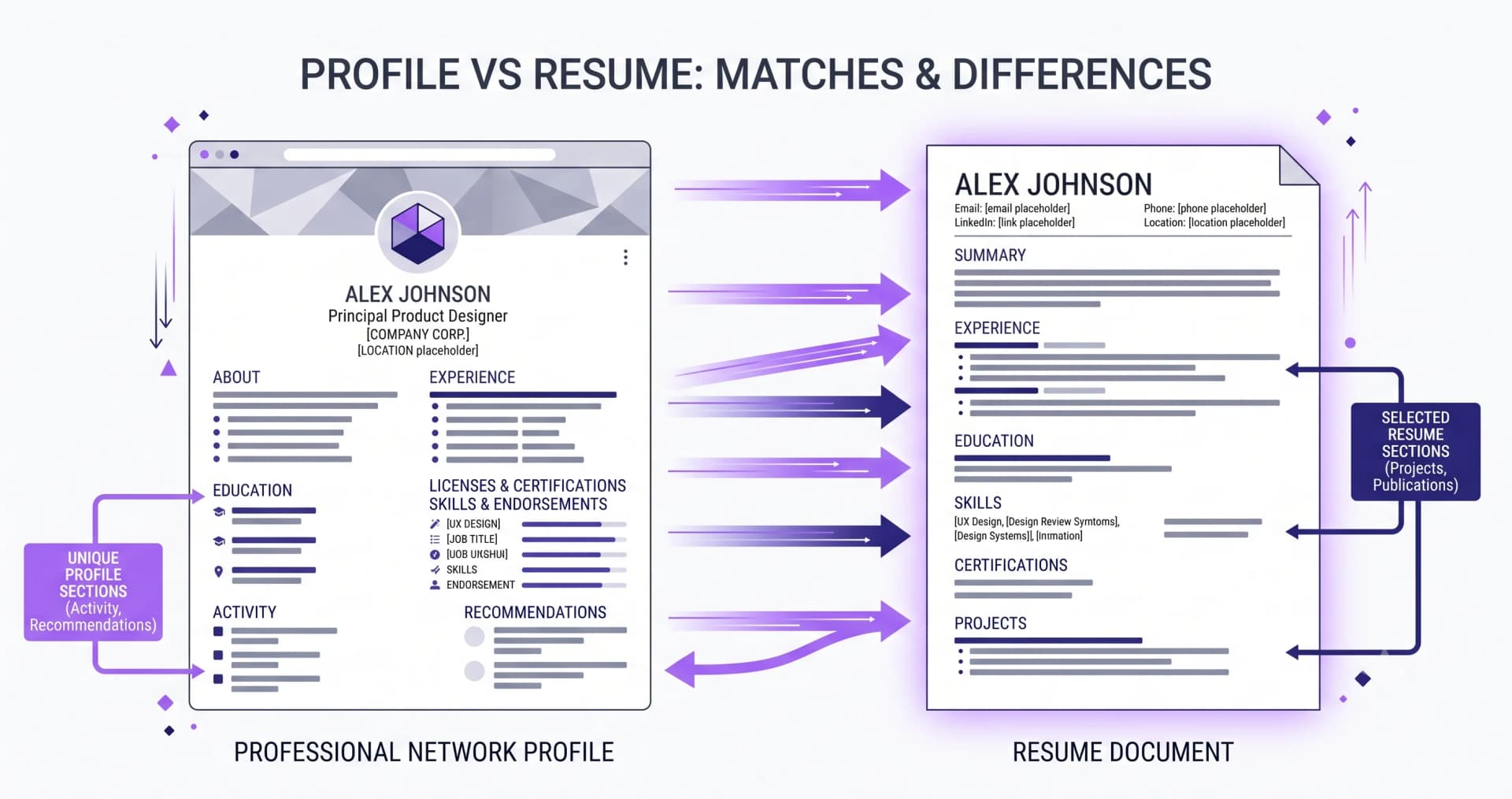
A resume argues for one specific job to one reader. A LinkedIn profile has to attract many different readers for jobs that haven't been posted yet. Copy-pasting one into the other wastes both.
What should be identical
Employers, job titles and dates. Recruiters cross-check these, and a discrepancy — even an innocent one from an old profile you never updated — reads as a red flag during background verification.
What should differ
- Headline — the resume has none; LinkedIn's is searchable and appears everywhere you comment
- About — first person and conversational on LinkedIn, third-person-implied and terse on a resume
- Breadth — the resume cuts anything irrelevant to one job; the profile keeps range, because you don't know who's searching
- Recommendations and endorsements — LinkedIn-only social proof
- Content — posts, comments and articles have no resume equivalent and drive most inbound recruiter interest
The headline is a search field
LinkedIn's recruiter search weighs the headline heavily, and it's what appears next to your name in every search result. Use the format: role · core skills · location, and add what you're looking for if you're actively searching.
Software Engineer | Passionate about technology | Lifelong learner
Backend Engineer · Python, Django, AWS · Payments & fintech · Bengaluru
Write About in first person
Three short paragraphs: what you do and the proof, what you're known for, what you're open to. First person reads naturally on LinkedIn and stiffly on a resume — this is the one place to write like a person rather than a document.
The settings that actually matter
- Open to work — recruiter-only visibility if your current employer shouldn't see it
- Custom URL — linkedin.com/in/ashaverma, which is what goes on your resume
- Location set to the city you want , not necessarily where you are
- Skills — order them; the top three appear on your profile and are endorsed most
Photo and banner
Profiles with a photo get substantially more responses — this is the opposite of resume advice, because LinkedIn is a network rather than a blind screen. A plain headshot and a simple banner are enough; no design skill required.
Put this into practice
Build, score and tailor your resume with JotCV — free plan, no card needed.
Add a portfolio to your profile