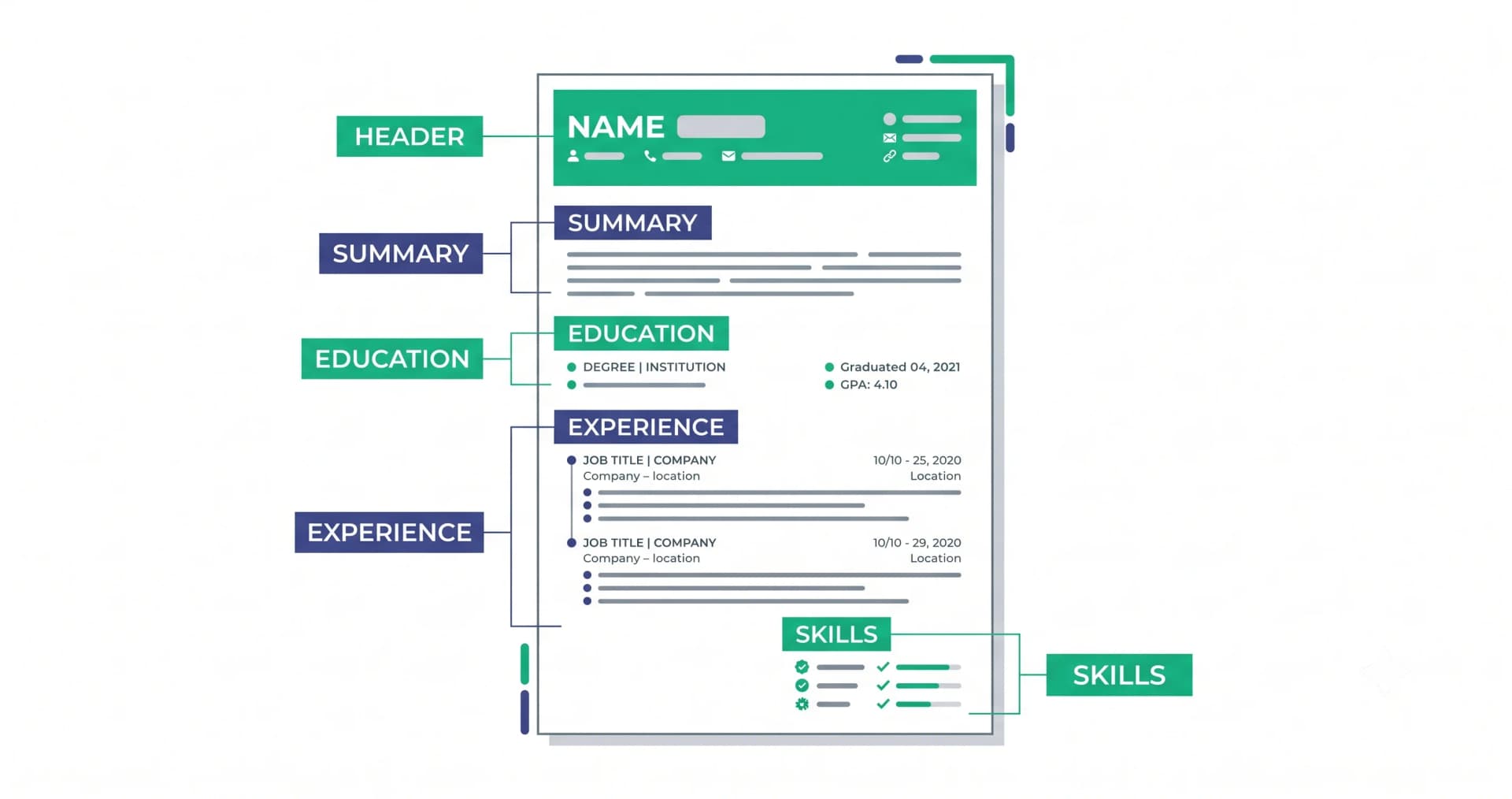
This is the resume you write once and then adapt for years. Getting the skeleton right now saves you rebuilding it every time you apply somewhere new.
Header — five items, one line each
Full name in the largest text on the page. Under it: phone with country code, a professional email address, your city, and one link (LinkedIn, GitHub or portfolio — whichever is strongest). No full postal address, no date of birth, no photo unless the employer asks.
Summary — two sentences, written last
Write this after everything else, because it's a summary of the page, not an introduction to you. Sentence one: who you are and your strongest proof. Sentence two: what you're looking for.
B.Com graduate (2026, Christ University) with a 5-month accounts internship handling GST filings for 30+ small clients. Looking for an accounts executive role in Bengaluru.
Education — degree, institution, year, one number
One line per qualification, newest first. Add a second line only for genuinely relevant coursework or a thesis. School details compress to a single line each, and disappear entirely once you have work experience.
Experience or Projects — the part that decides it
Three to five bullets under each entry, each starting with a past-tense verb and containing one fact a reader couldn't have guessed. If you've had any job, internship or paid freelance work, this section comes before Projects. If not, Projects takes its place and its prominence.
Skills — grouped and honest
Two or three lines maximum, grouped by type. Drop anything you couldn't answer a basic question about, and drop 'MS Office' unless the job specifically involves Excel — in which case say what you can do in it ('Excel: VLOOKUP, pivot tables, Power Query').
The optional last section
One of: Achievements, Certifications, Positions of Responsibility, or Languages. Pick the one with the strongest content and give it three lines. Adding all four with one weak line each makes the page look like it's filling space — because it is.
Put this into practice
Build, score and tailor your resume with JotCV — free plan, no card needed.
Start with this structure